Classic cars need a different approach to tuning. Whether you're running a set of Weber DCOEs on a straight six, a Holley four-barrel on a V8, or an early fuel injection system, the fundamentals are the same: get the fuelling right, optimise the timing, and make sure it's safe.
At The Torque Lab, classic cars are a regular part of our dyno tuning schedule. Here's how we approach tuning them.
Why dyno tune a classic?
Classic car engines are rarely running at their best. Factory calibrations were designed with the manufacturing tolerances and fuel quality of decades past. Rebuilt engines have different compression ratios, cam profiles, and airflow characteristics than stock. Carburettor changes, exhaust upgrades, and ignition modifications all change the equation.
A dyno tune lets us see exactly what's happening inside the engine in real time - air/fuel ratios, ignition timing, exhaust gas temperatures, and power output. Instead of guessing at jet sizes or timing curves, we can measure, adjust, and verify.
The result is more power, better drivability, and the confidence that your engine is running safely.
Hub dyno advantage for classics
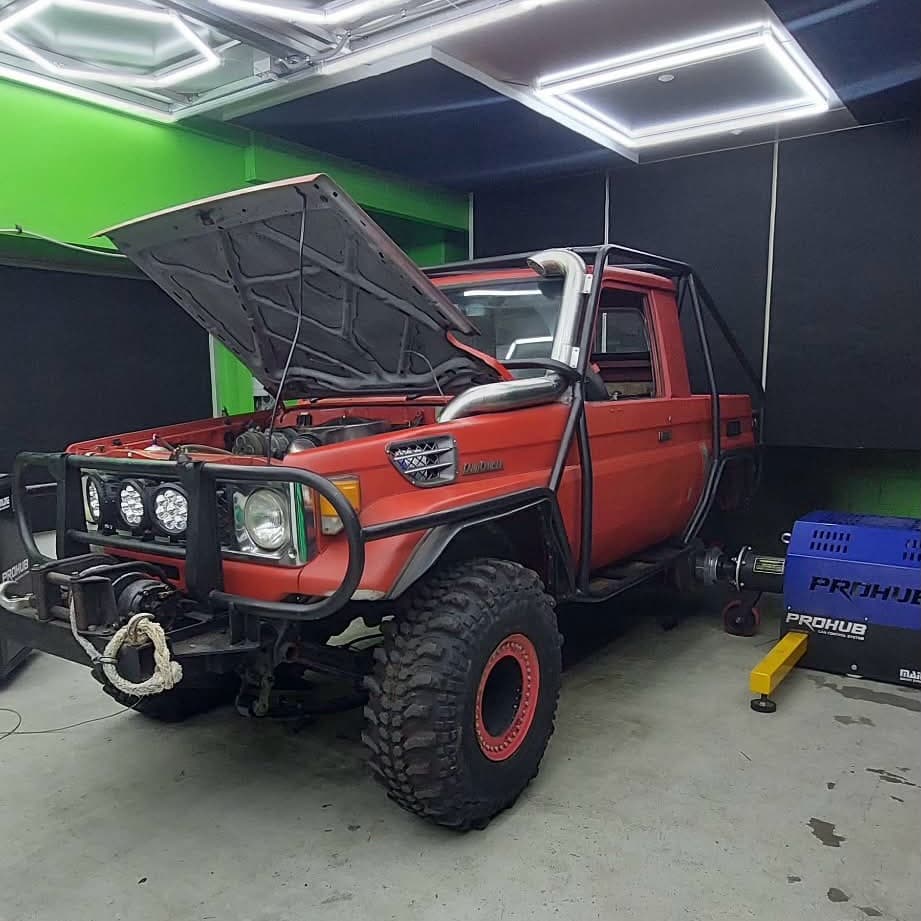
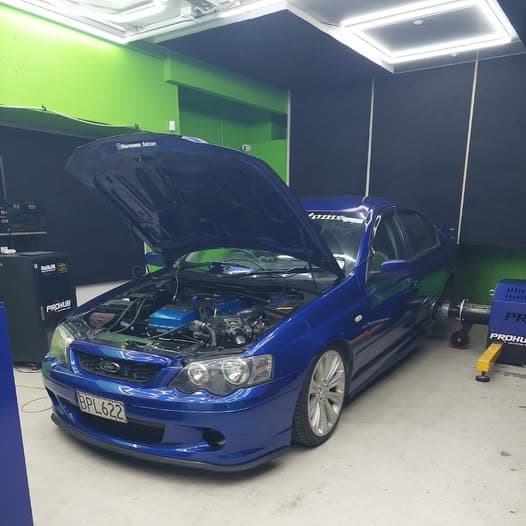
Our Mainline hub dyno is ideal for classic cars. It connects directly to the wheel hubs rather than using rollers. This matters for classics because:
- No tyre slip - classic car tyres are often narrow, hard, or non-standard sizes that slip badly on roller dynos. Hub connection eliminates this completely.
- No heat build-up - tyres don't heat up and degrade during extended tuning sessions.
- Accurate and repeatable - hub connection gives far more consistent results than rollers, making it easier to measure small changes between jet swaps or timing adjustments.
- Safe for valuable cars - no risk of the vehicle jumping off rollers. The hub connection holds the vehicle securely.
What we tune
Australian classics:
Holden Commodore (VB-VL), Holden Torana, Ford Falcon (XR-XF), Ford Falcon (BA-FG), Valiant. Factory carburettor or EFI - we tune both.
British classics:
MG, Triumph, Austin-Healey, Jaguar, Mini. Weber DCOE conversions, SU carburettors, and Stromberg setups.
American V8s:
Chevrolet small-block and big-block, Ford Windsor and Cleveland, Chrysler Hemi and Wedge. Holley, Edelbrock, and Rochester carburettors. LS swaps with modern EFI.
Japanese classics:
Datsun 240Z/260Z/280Z, Toyota Celica, Mazda RX-3/RX-7, Honda S800. Weber DCOE, Mikuni, and factory EFI.
Carburettor types:
Weber DCOE and DCNF, Holley four-barrel and double pumper, SU, Stromberg, Mikuni, Solex, Dellorto, Rochester Quadrajet, Carter AFB, Edelbrock.
Carburettor tuning on the dyno
Carburettor tuning is where the dyno really earns its keep. The process:
- Baseline runs with wideband O2 sensor to measure air/fuel ratio across the rev range
- Main jet selection to achieve target AFR at full load (typically 12.5-13.0:1 for NA, richer for forced induction)
- Air corrector and emulsion tube matching to shape the fuel curve through the mid-range
- Idle circuit calibration - idle jet, mixture screw, and progression hole positioning
- Accelerator pump tuning for clean throttle response with no flat spots
- Ignition timing optimisation - total advance, curve shape, and vacuum advance calibration
- Final verification runs to confirm the tune is safe, consistent, and making good power
For a detailed breakdown of Weber DCOE tuning, read our Weber carburettor tuning guide.
EFI classics
Many classic cars now run aftermarket EFI systems - Haltech, Link ECU, MoTeC, or even factory EFI from the 80s and 90s. These get the full standalone ECU treatment on the dyno: fuel maps, ignition maps, idle control, cold start enrichment, and acceleration enrichment all calibrated with real-time data.
For factory EFI systems (like Holden VN-VT or Ford EL-AU), we can remap the factory ECU where supported, or recommend a standalone upgrade if the factory system is limiting.
What does it cost?
Classic car dyno tuning at The Torque Lab typically costs:
- Carburettor tune (single carb): $500-$700 NZD
- Carburettor tune (multiple carbs): $600-$900 NZD
- EFI/standalone ECU tune: $800-$1,500+ NZD
- Factory ECU remap (where supported): $500-$900 NZD
Pricing depends on the complexity of the setup and how far the current calibration is from optimal. Every tune includes before-and-after dyno sheets.